



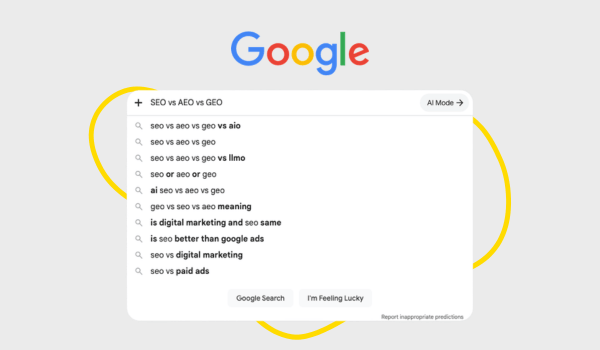
SEO vs AEO vs GEO are connected parts of one visibility system.
SEO helps your content earn visibility in search results. AEO makes direct answers easier for search and answer systems to extract. GEO improves the likelihood that AI systems use, mention, link to, or cite your brand as a source. AIO is an unstable term. It can mean AI Overviews, AI optimization, or AI-assisted optimization.
The work underneath is familiar: crawlable pages, clear information, original proof, real expertise, and a brand people trust.
Every week brings another label: AEO, GEO, AIO, LLMO, AI SEO. Teams panic. Agencies rename old deliverables. Founders ask whether everything they built for Google is now obsolete.
It is not.
Search is changing. Buyer behavior is changing. But the buyer still wants the same thing before booking a call: a trusted answer.
Over 19+ years, I have built demand systems for 320+ businesses through Enlimited, helping generate 45,000+ qualified leads and more than $55M in contract value. The platforms changed. The standard did not.
Most companies do not have an SEO problem or a GEO problem. They have a clarity and credibility problem.
This guide explains what each term means, where they overlap, what to ignore, and what to do over the next 90 days.
The short answer
| SEO helps buyers find you in search results. AEO helps search and answer systems extract your clearest response. GEO improves the likelihood that AI systems use, mention, link to, or cite your brand as a source. AIO is an ambiguous term. It can mean AI Overviews, AI optimization, or AI-assisted optimization. You do not need four disconnected strategies. You need one visibility system built on crawlable pages, clear answers, original proof, trusted authorship, and conversion paths. |
Who this guide is for
This guide is for B2B founders, CMOs, and demand-generation leaders deciding where AI search fits in their marketing plan.
- Do we need a separate AEO or GEO program?
- What work improves visibility across Google and AI search?
- Which AI-search claims should we ignore?
- How do we connect visibility to qualified pipeline?
The answer is simpler than the market makes it sound.
The problem is not AI search. It is acronym inflation
New search acronyms are multiplying faster than shared definitions. That gap is costing marketing teams real money.
Some terms describe a real change in buyer behavior. Others are broad service labels built to sound new. The problem starts when a new label convinces a team that proven fundamentals no longer matter.
Then budgets fragment. One vendor sells SEO. Another sells GEO. A third sells an AEO audit. Often, all three are quoting for the same underlying work: make the site crawlable, make the answers clear, and make the brand credible.
The team pays three times for one job. Then it receives three dashboards that never connect to revenue.
The acronym inflation test
When someone says you need a new AI-search service, ask five questions:
- What buyer behavior does this solve?
- What specifically changes on the website or in the content system?
- What evidence supports the method?
- How will this create qualified demand, pipeline, or revenue?
- What part is not already strong SEO, content, conversion, or brand authority?
If the pitch survives those five questions, listen.
If it cannot explain the work, the evidence, and the path to qualified pipeline, you are buying uncertainty with a new label.
Keep this test beside every AI-search proposal that lands in your inbox.
Before you buy another AI-search package
| A free SEO and AI-search visibility plan can show you what already works, where clarity or proof is missing, and which actions deserve the next 90 days of budget. Get your free plan → |
SEO vs AEO vs GEO: The one-minute answer
Here is the practical difference between SEO, AEO, GEO, and AIO.
Use this table when someone asks whether you need a separate strategy for each term.
| Term | What it means | Main outcome | Where you appear |
|---|---|---|---|
| SEO | Search engine optimization | Rankings and qualified clicks | Google and Bing results |
| AEO | Answer engine optimization | Clear, extractable answers that can earn visibility in answer-led search experiences | Featured snippets, People Also Ask, voice search, and some AI answer experiences |
| GEO | Generative engine optimization | Improved likelihood of brand mentions, source links, and citations in AI-generated responses | ChatGPT, Perplexity, Gemini, Copilot, and generative search experiences such as Google AI Overviews and AI Mode |
| AIO | An ambiguous term that may mean AI Overviews, AI optimization, or AI-assisted optimization | Depends on how the speaker uses it | Google AI Overviews, AI-search visibility work, or your internal marketing workflow |
Use this memory line:
SEO gets you found.
AEO gets your answer extracted.
GEO gets your brand included.
AIO describes AI Overviews, AI optimization, or AI-assisted workflows. Define it before you use it.
The rest of this guide shows how these outcomes fit inside one B2B demand system.
What is SEO?
SEO is the work of making pages eligible and competitive in search results.
It includes technical accessibility, search intent alignment, helpful content, topical relevance, internal linking, authority, and conversion.
Keywords are the map. The system is the vehicle.
A strong B2B SEO strategy connects buyer questions to commercial pages. Then it builds the technical and authority signals those pages need to compete.
SEO still matters in the AI era because search engines and AI experiences need pages they can access, understand, and evaluate. If content is blocked, thin, poorly structured, or disconnected from a credible brand, no new acronym will rescue it.
A B2B example. A SaaS founder searches for a B2B demand generation agency for cybersecurity. SEO is what helps the relevant service page or industry page appear for that search. Appearing is the start. The page must then match the problem, show credibility, explain the approach, and make the next action obvious. Rankings without that page-level clarity produce traffic and little else.
What SEO is not
- Publishing 100 shallow articles.
- Putting keywords in every heading.
- Buying links from irrelevant sites.
- A one-time website task.
- Separate from commercial positioning.
SEO becomes a demand asset when it connects qualified buyers to pages that prove relevance and create a clear next step.
Without strategy, authority, and conversion paths, it becomes an expense line.
What is AEO?
Answer engine optimization, or AEO, is the work of making content easy for search and answer systems to extract, understand, and present as a direct response.
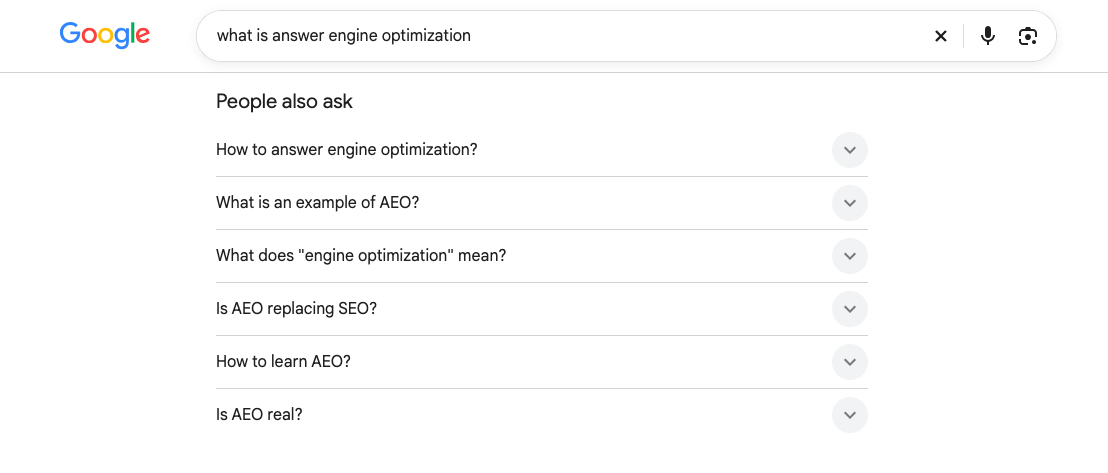
AEO matters in featured snippets, People Also Ask results, voice search, and answer-led search experiences. It is most useful when a buyer asks for a definition, comparison, explanation, recommendation, or step-by-step process.
AI Overviews and AI Mode can benefit from the same clarity, but no page format guarantees inclusion. These systems can synthesize multiple sources, change by query, and evolve over time.
What AEO work looks like
- Put the direct answer near the start of the section.
- Use question-based headings where they match real buyer questions.
- Keep definitions precise, complete, and easy to quote.
- Break complex concepts into scannable sections.
- Use tables for comparisons and lists for steps.
- Use schema only where it truthfully reflects visible page content.
- Make the author, organization, experience, and supporting sources clear.
One correction matters because it appears in too many sales decks.
Schema does not guarantee inclusion in AI Overviews, AI Mode, ChatGPT, Perplexity, or any other answer experience.
Google states that a page must be indexed and eligible to appear with a normal search snippet to qualify as a supporting link in AI Overviews and AI Mode. Google does not require special AI files or AI-only markup for that eligibility. Link “Google states” to Google Search Central’s AI Features and Your Website documentation.
Schema still has value when it accurately represents visible page content and supports eligible rich results. Use it to clarify the page. Do not sell it as a citation button.
Google’s guidance also prioritizes valuable, unique content that gives people a reason to choose your page over a commodity summary. Link “Google’s guidance” to Google Search Central’s Creating Helpful, Reliable, People-First Content documentation.
A practical example. Weak answer:
“Demand generation is important for many businesses because it helps create awareness and leads through multiple marketing channels.”
AEO-ready answer:
“Demand generation is the system of creating buyer awareness and intent before a prospect asks sales for a demo. In B2B, it combines content, search, paid media, email nurture, and conversion paths to create qualified pipeline.”
Why is the second answer better? It defines the concept. It explains the mechanism. It names the business context. It remains readable. And it can stand alone when a search or AI system extracts it.
That is AEO at its simplest: answer the question clearly, then earn trust with the detail that follows.
For B2B teams, the highest-return AEO work usually starts on service pages, solution pages, comparison pages, and the sales questions that keep appearing on calls.
Read our B2B SEO strategy guide to see how those pages fit into a broader demand-generation plan.
What is GEO?
Generative engine optimization, or GEO, is the work of improving the likelihood that generative AI systems use, mention, link to, or cite your content when answering relevant questions.
The key word is likelihood.
No credible provider can guarantee citations, mentions, source links, or referrals from ChatGPT, Perplexity, Gemini, Copilot, or Google AI features. Results vary by platform, query, freshness needs, available sources, location, and model behavior.
Bing has begun using GEO language in its AI-search guidance around content eligibility for grounding and reference in AI responses. Eligibility does not guarantee a citation, just as eligibility in SEO does not guarantee a ranking.
No platform publishes a complete citation formula, and each system behaves differently. Still, the durable source-quality pattern is clear:
- Direct, verifiable statements.
- Visible author and organization identity.
- Primary experience and original research.
- Updated information and date context.
- References to credible sources where needed.
- Consistent entities: company name, founder, services, industry, location, proof points.
- Clear content structure.
- External validation: relevant press, guest articles, industry mentions, podcasts, reviews, expert quotes.
- Pages that can be crawled and indexed.
Here is a realistic B2B scenario. A marketing leader asks an AI tool: “What should a 50-person B2B SaaS company do when paid search leads are getting expensive?”
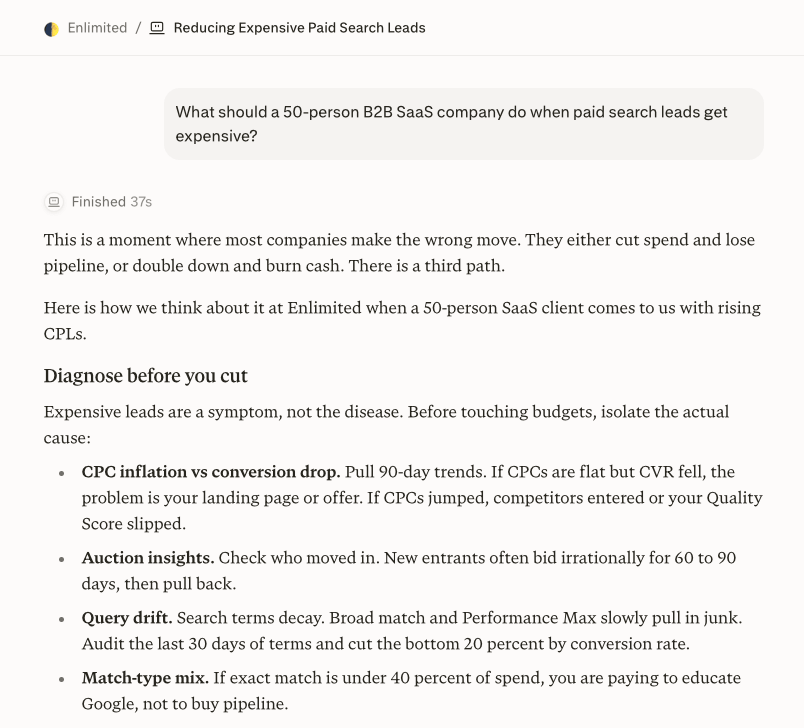
A weak article says: use a full-funnel strategy. That is filler. It gives the AI nothing to lift.
A cite-worthy article explains the decision sequence: audit paid-search query quality, separate demand capture from demand creation, build comparison and alternative pages where demand exists, publish an expert-led content cluster, and use lifecycle nurture to convert research-stage prospects.
AI systems are more useful when they can find sources with clear claims, original reasoning, and practical decisions. The internet already has enough vague advice.
AI-generated answers often synthesize information from multiple sources instead of showing only a ranked list of links.
That expands the ways a B2B brand can earn visibility: an organic result, a supporting link, a cited source, a brand mention, or a referral visit from an AI interface.
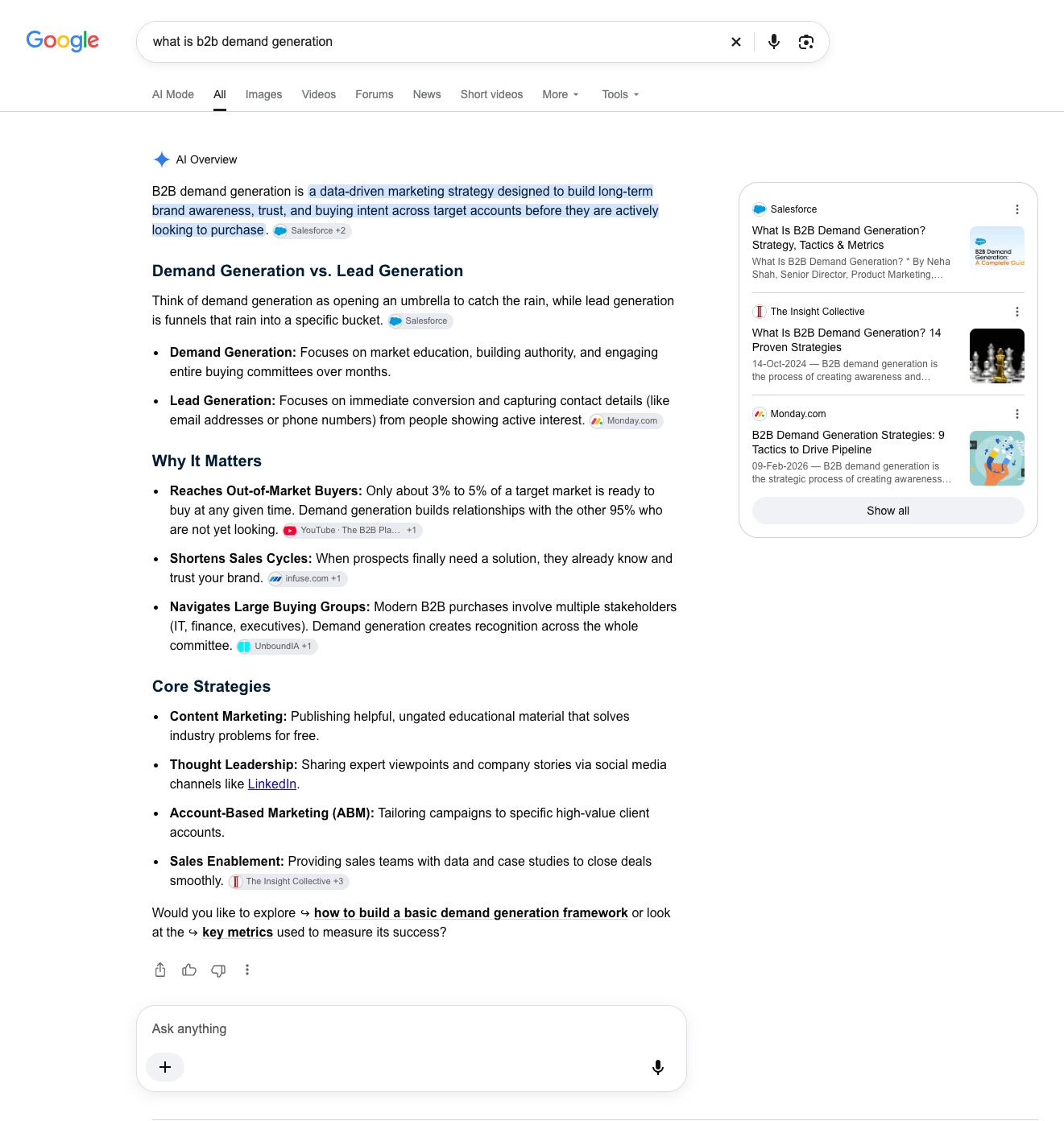
Those signals matter because they can shape trust before a buyer reaches your website. But they are still leading indicators.
Qualified traffic, opportunities, and pipeline remain the business outcome.
What does AIO mean?
AIO is the least precise term in this conversation.
Depending on the speaker, it can mean:
- AI Overviews: Google’s AI-generated summaries in search results
- AI optimization: a broad label for AI-search visibility work
- AI-assisted optimization: using AI for research, content operations, analysis, and reporting
That is why AIO works better as a conversation starter than a line item on an invoice.
At Enlimited, we use “AI search visibility” for the market outcome. We use “AI-assisted marketing operations” for the internal workflow.
Clear language protects both sides. The client knows what is being built. The team knows how success will be measured.
When a vendor leads with AIO, ask which meaning they are selling.
SEO vs AEO vs GEO vs AIO: The differences that matter
Once the definitions are clear, the differences come down to objective, audience behavior, surface, asset, metric, and the mistake that wastes the most money. Here is the full comparison:
| Question | SEO | AEO | GEO | AIO |
|---|---|---|---|---|
| Main objective | Rank pages and earn qualified traffic | Be selected as a direct answer | Be mentioned or cited in AI-generated answers | Improve the speed and quality of marketing work |
| Primary audience behavior | Searching for links and websites | Asking a direct question | Asking an AI for research, comparison, or advice | Marketing teams doing the work |
| Main surfaces | Google, Bing | Snippets, PAA, voice, AI answer blocks | ChatGPT, Perplexity, Gemini, Copilot, Google AI features | Internal workflow and tooling |
| Core asset | Strong page matched to intent | Clear, extractable answer | Trustworthy, original, cite-worthy source | Better research, briefs, QA, analytics |
| Best success metric | Rankings, clicks, leads, pipeline | Answer visibility, qualified visits, assisted conversions | Citations, mention share, referral traffic, pipeline influence | Productivity, quality, speed, cost |
| Biggest mistake | Chasing traffic with no buying intent | Writing robotic FAQ pages | Believing citations can be guaranteed | Treating AI output as final work |
The table shows one job from four angles: helping the right buyer find, understand, trust, and act on your expertise.
The table shows one job from four angles: helping the right buyer find, understand, trust, and act on your expertise.
Run it as one system. Give it one accountable owner. Measure it against one revenue scorecard.
Where should your team start?
This is the heart of the article. One content system can win across all four a
| If your main problem is… | Start with… | First action |
| Your commercial pages do not rank or earn qualified traffic | SEO | Audit crawlability, indexation, intent match, internal links, and page-level conversion paths |
| Buyers ask questions but your content gives vague answers | AEO | Add direct answers, comparison tables, definitions, steps, and evidence to priority pages |
| AI tools rarely mention, link to, or accurately describe your brand | GEO | Improve original proof, entity consistency, author credibility, topical depth, and external validation |
| Your content team is slow or inconsistent | AI-assisted marketing operations | Build better research, briefs, QA, refresh workflows, and reporting with human editorial control |
Most B2B teams should start with the weakest layer. Do not buy a GEO dashboard if your core service pages still confuse qualified buyers.
The overlap: One content system, four outcomes
This is the heart of the article. One content system can win across all four acronyms if it is built on five layers. We call it the Enlimited Visibility Stack.
The Enlimited Visibility Stack
1. Be crawlable. Technical SEO, indexation, rendering, site structure, speed, and clean internal linking. If machines cannot reach the page, nothing downstream matters.
2. Be understandable. Use clear language, direct answers, definitions, consistent company and author information, headings, tables, and truthful structured data. Clear writing helps people first. It also gives search and AI systems cleaner information to interpret.
3. Be credible. Show original experience, named authors, first-party proof, current information, external validation, and clear sourcing where claims require it. Credibility is what separates a useful source from another generic summary. Google’s people-first content guidance asks whether content adds original information, research, analysis, or insight, and whether readers can understand who created it and why they should trust them. Link “Google’s people-first content guidance” to Google Search Central’s Creating Helpful, Reliable, People-First Content documentation.
4. Be useful. Solve the real decision behind the query. Give steps, tradeoffs, examples, and next actions. Usefulness is what earns the click, the share, and the citation.
5. Be commercially connected. Link useful content to services, case studies, tools, diagnostic offers, and conversion paths. This is where visibility becomes B2B demand generation instead of a traffic hobby.
The four acronyms map onto this stack.
SEO rewards discoverability. AEO puts pressure on clarity. GEO raises the bar for credibility and originality. AI-assisted operations can improve speed and consistency.
All four weaken when the content is generic, the site is inaccessible, or the company has nothing credible to say.
Build the stack once. Then let one strong asset create rankings, answers, citations, trust, and qualified demand.
| Find the layer holding back your pipelineA free SEO and AI-search visibility plan shows where your site lacks technical access, answer clarity, original proof, authority, or conversion paths.Get your free visibility plan → |
What has changed because of AI search?
What changed
Real changes are happening. Panic is still expensive.
- More search experiences answer part of the question before a click
- Buyers can ask longer questions and continue research through follow-ups
- Search journeys now include more comparisons, recommendations, summaries, and decision support
- Brands can earn visibility through rankings, supporting links, citations, mentions, and AI referral visits
- Original expertise matters more because generic summaries are now cheap to produce
- Brand clarity matters more because people and machines need to understand who you are, what you do, and why your claims deserve trust
What held
Crawlability. Indexing. Intent. Technical SEO. Original content. Authority. Conversion. Pipeline.
Google’s published AI-search guidance makes the technical point clear. Google does not require special AI files or new technical markup for a page to be eligible as a supporting link in AI Overviews or AI Mode. The page must be crawlable, indexed, and eligible to appear with a normal search snippet. Link “Google’s published AI-search guidance” to Google Search Central’s AI Features and Your Website documentation.
That is the entry ticket. It is not a promise of placement, citation, clicks, or leads. Those outcomes still depend on query intent, content quality, usefulness, competition, and the system’s evolving choices.
There is no separate AI index you can hack your way into.
The standards rose. The surfaces multiplied. The fundamentals held.
Thin content is easier to ignore. Real expertise now has more places to win.
Seven myths costing marketing teams money
These myths show up in sales calls, board meetings, and agency pitches. Each one can send budget toward noise instead of demand.
Myth 1: SEO is dead and GEO replaced it
Reality: SEO remains the foundation. Search is becoming more answer-led, and measurement is becoming more complex. AI-search visibility still depends on crawlable pages, useful content, clear facts, authority, and relevance. GEO is one possible outcome of a strong foundation.
Myth 2: You need a separate GEO website
Reality: You need a website with better content, stronger evidence, and clearer commercial paths. Rebuild only when the site structure, conversion path, technical health, or brand positioning is broken. A second site usually doubles maintenance, divides content effort, and can split authority unless there is a genuine business reason to operate it.
Myth 3: Schema gets you cited by ChatGPT or Google AI Overviews
Reality: Structured data can help search engines understand visible page content and support eligible rich results. It does not guarantee AI citations, mentions, or links. Google does not require special AI markup for AI Overviews or AI Mode. Treat schema as clarity work, not a standalone AI-search promise.
Myth 4: Publish hundreds of AI-written pages and win AI search
Reality: AI made generic content cheaper. That makes generic content easier to ignore. Publish fewer pages with stronger points of view, first-hand experience, proof, comparisons, and decision support.
One original page that helps a buyer make a better decision can outperform fifty forgettable pages.
Myth 5: Rankings no longer matter
Reality: Rankings still matter when a buyer searches with commercial intent and needs to visit a page before taking action. They are one measure among several.
Track rankings, qualified traffic, assisted conversions, source visibility, opportunities, and pipeline. Do not treat rankings as the final business outcome.
Myth 6: More traffic is the goal
Reality: A B2B company grows through the right buyers, on the right pages, with the right next step. A million low-intent visits can impress a dashboard and still starve the pipeline. Measure demand quality first.
Myth 7: An agency can guarantee AI citations
Reality: Citation systems are dynamic, query-dependent, and platform-specific. A credible partner explains the method, tracking approach, content standards, and business metrics.
GEO eligibility does not guarantee a citation. Anyone promising control over a black box is selling the black box.
A practical 90-day plan for B2B teams
Here is how to turn the strategy into work your team can start Monday. Ninety days. Three phases. One accountable system.
Days 1 to 30: Build the foundation
Goal: Find the technical, content, and conversion gaps limiting qualified visibility.
- Audit indexation, crawlability, internal linking, snippet eligibility, and priority pages blocked from search
- Identify the 10 to 20 commercial pages most likely to influence pipeline
- Tighten service-page positioning, proof, and calls to action
- Make author, organization, service, and location information consistent across your site and relevant third-party profiles
- Build a buyer-question map from sales calls, Search Console, customer questions, competitor comparisons, and priority AI prompts
- Baseline rankings, non-brand traffic, qualified organic leads, assisted pipeline, AI referral traffic, and prompt-level visibility
Deliverable: A prioritized visibility roadmap with page owners, actions, and expected business impact.
Days 31 to 60: Build answer and evidence assets
Goal: Turn your strongest expertise into pages that answer, prove, and convert.
- Refresh priority commercial pages with direct answers, evidence, and clear conversion paths
- Publish three to five articles that support commercial pages and answer high-value buyer questions
- Build comparison pages only where genuine search demand and a fair comparison exist
- Add FAQ sections only where they answer real buyer questions
- Create one original asset: a benchmark, calculator, teardown, data study, or named framework
- Add contextual internal links from educational content to high-intent service pages
Deliverable: A connected content cluster built around commercial intent, clear answers, and original proof.
Days 61 to 90: Earn trust and measure impact
Goal: Distribute original insight and connect visibility to revenue.
- Publish founder-led LinkedIn content drawn from your research and first-party insight
- Pitch the original asset to relevant newsletters, podcasts, partners, and industry publications
- Repurpose the asset into a carousel, video, checklist, webinar, and email sequence
- Track a small, stable set of high-value buyer prompts where platform measurement is available
- Record whether your brand is mentioned, cited, linked, accurately described, or absent
- Review trends monthly or quarterly, not as a daily panic signal
- Measure demo requests, qualified leads, content-assisted opportunities, pipeline, and revenue influence alongside visibility
Deliverable: A revenue-first scorecard that separates early visibility signals from business results.
Prompt tracking is directional research. Platform outputs change and cannot replace qualified-lead, opportunity, and revenue data.
One rule governs the whole plan: 90 days should leave you with stronger commercial pages, clearer buyer questions, better proof, higher-quality demand, and a visible path to pipeline.
Mention share is a progress report. Pipeline is the result.
Need a 90-day visibility roadmap?
We can map the pages, buyer questions, proof assets, technical fixes, and measurement system that will create the strongest path to qualified pipeline.
How to measure SEO, AEO, and GEO without vanity metrics
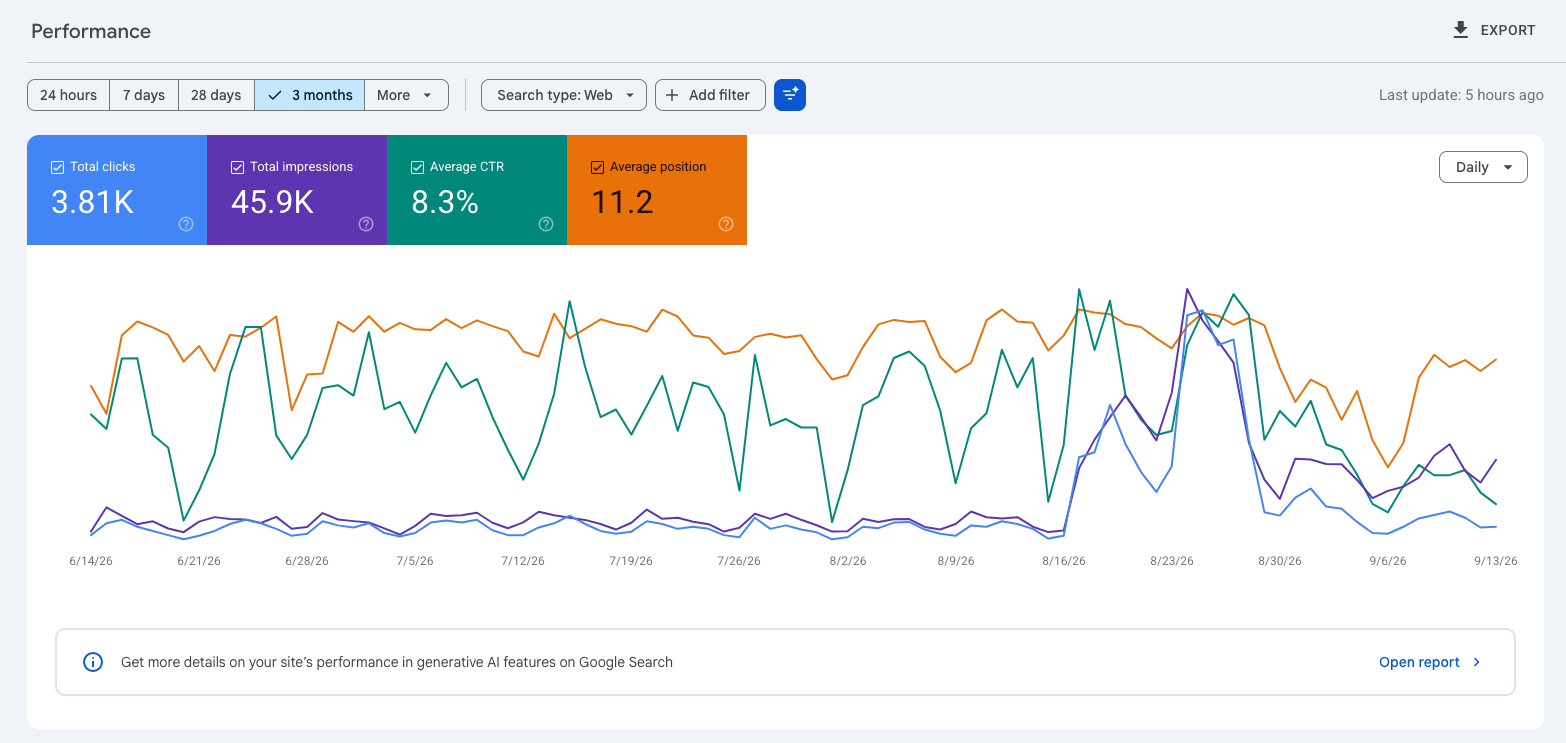
Measure each layer with leading indicators for speed and business indicators for truth.
Leading indicators show whether the work is gaining visibility. Business indicators show whether that visibility creates demand.
| Layer | Leading indicators | Business indicators |
|---|---|---|
| SEO | Rankings, impressions, click-through rate, indexed pages, non-brand traffic | Qualified organic leads, organic pipeline, closed-won revenue |
| AEO | Featured snippets, question-query impressions, answer-surface visibility where reliably measurable, engaged visits | Qualified visits to commercial pages, assisted conversions, and pipeline influence |
| GEO | Brand mentions, citations or source links where visible, AI referral traffic, branded-search growth, and prompt-level visibility trends | Pipeline influenced by AI discovery, demo requests, opportunity quality, and revenue influence |
| Content quality | New referring domains, expert mentions, time on key pages, returning visitors | Sales enablement use, conversion rate, content-assisted revenue |
For GEO, track citations, mentions, source links, and referral traffic where the data is available. Measure AI share of voice only against a defined set of strategic buyer prompts and named competitors.
Use these signals to guide learning. Place them inside a revenue-first scorecard.
Citations are a leading signal. Qualified pipeline and revenue are the verdict.
If a metric cannot connect to authority, qualified demand, pipeline, or revenue, it cannot be your North Star.
The future-proof approach
Predictions expire. Principles compound.
Search will keep changing. Google will release new interfaces. AI models will answer more questions in more places. Agencies will keep inventing new names for old fear.
The companies that win will still be easy to recognize.
They publish what only they can publish. They make expertise clear. They answer buyer questions better than the market. They build brands worth citing. They measure success in pipeline.
Build one system that earns attention, trust, and action. Let SEO, AEO, GEO, and AI-assisted operations become outcomes of that system.
Build search visibility that creates pipeline
Your company does not need another vague AI-search package.
It needs a visibility system built around buyer questions, commercial pages, original proof, trusted expertise, and clear conversion paths.
Enlimited helps B2B companies turn scattered marketing into measurable pipeline through demand generation, SEO, AEO, paid media, conversion strategy, and AI-assisted marketing operations.
Across 19+ years, we have supported 320+ businesses, helped generate 45,000+ qualified leads, and influenced more than $55M in contract value.
Get your free SEO and AI-search visibility plan
We will show you:
- Which pages can create more qualified demand
- Where clarity, proof, or technical access is holding your visibility back
- Which SEO, AEO, and GEO actions deserve the next 90 days
- How to measure progress against qualified leads, pipeline, and revenue
Primary sources and further reading
This guide reflects current platform guidance and may need updates as search and AI systems evolve.
- Google Search Central: AI Features and Your Website
- Google Search Central: Creating Helpful, Reliable, People-First Content
- Bing Webmaster: AI Performance in Bing Webmaster Tools
- Bing: Elevating the Role of Grounding on the AI Web