






































AI Agent Development Company for B2B

AI agents that ship past demo, into production.

We are an AI agent development company for B2B teams. Agents built with guardrails, evals, and a business KPI, not proof-of-concept theater.

B2B AI agent problems

Why B2B AI agent projects die between demo and production.

67b85fd669f0e94f90890dc8_Section 3

Demo, never production.

Production readiness starts in sprint one: evals, guardrails, and monitoring, not later.
Map_73890c8164

No eval harness.

A regression suite runs before every deploy, so prompt changes cannot quietly break it.
Group_2147257472_8e84a1a46c

Injection unguarded.

Input and output validation is built in and tested with adversarial prompt sets early.
Group_2147257450_9ca64fb8c8

Hallucinated answers.

Responses are grounded in your data with RAG, and drift is monitored after every release.
Group_2147257378_b7076b3849

Framework by hype.

LangGraph, CrewAI, AutoGen, or native SDKs, picked by workload and latency, not by trend.
Group_2147257346_579c25583e

No business KPI.

Meetings booked, tickets resolved, or hours saved goes in the contract and is read weekly.

Inside the Demand Engine

AI agents are just one part of a bigger revenue system.

AI agent services

What our AI agent builds include

Our AI Agent Development Services are scoped by shipped output, not tokens: AI SDR agents wired to your CRM, tier-1 support agents, research and account-plan agents, internal ops agents, RAG over private knowledge, and multi-agent orchestration.

Custom AI agents for B2B ship with evals, guardrails, monitoring, and human review on your cloud. It is the same discipline behind Introzy’s outbound build and the RepairDesk funnel that hit 280% of its MQL goal.

business-owner-working-their-strategy
logo design services

Why teams switch

Four things we do differently

Evals run before every deploy, on every prompt and model change, so regressions get caught in staging. Guardrails are a product, not an afterthought: validation aligned to OWASP guidance on prompt injection, the top LLM risk.

Marketing and engineering sit under one roof, so the agent and the pipeline it feeds are built together. And the engagement runs month to month, with a 30-day notice either way.

The first 90 days

What ships in the first quarter

Days 1 to 14: paid discovery locks the use case, data access, the eval set built from real cases, and the KPI target.

Days 15 to 45: agent v1 runs in staging with RAG connected, guardrails live, and human review in place.

Days 46 to 75: pilot users work with the agent and KPI reads arrive weekly.

Days 76 to 90: production rollout, the v2 roadmap, and a board-ready readout. Enterprise AI agent implementation moves this fast only when scope is locked first.

business-owner-working-their-strategy
logo design services

Scope and measurement

How we scope, price, and measure

Discovery is fixed price. Build work runs time and materials on exploratory modules, then fixed price once RAG, agent v1, and guardrails are locked. The post-launch pod covers prompt tuning, model swaps, and eval expansion, with market benchmarks on our pricing page.

Agentic AI development gets canceled for unclear business value: Gartner expects over 40 percent of agentic projects dropped by 2027. We report cost per action, eval pass rate, and the KPI in the contract.

Enterprise build results

Proof from builds that shipped and scaled.

65% Lower training costs

Enterprise Tech
$7.9M Pipeline influenced

Fintech
500% Company growth

Financial Services
300% More conversions

Law Firm
43% Pipeline growth

B2B SaaS
35+ Enterprise appointments

B2B SaaS

Start where your agent risk is highest.

One finds the leaks. The other proves the agent with users in 30 days.

Demand Engine Audit

For teams whose AI spend has not shipped past the demo.

Start the Audit
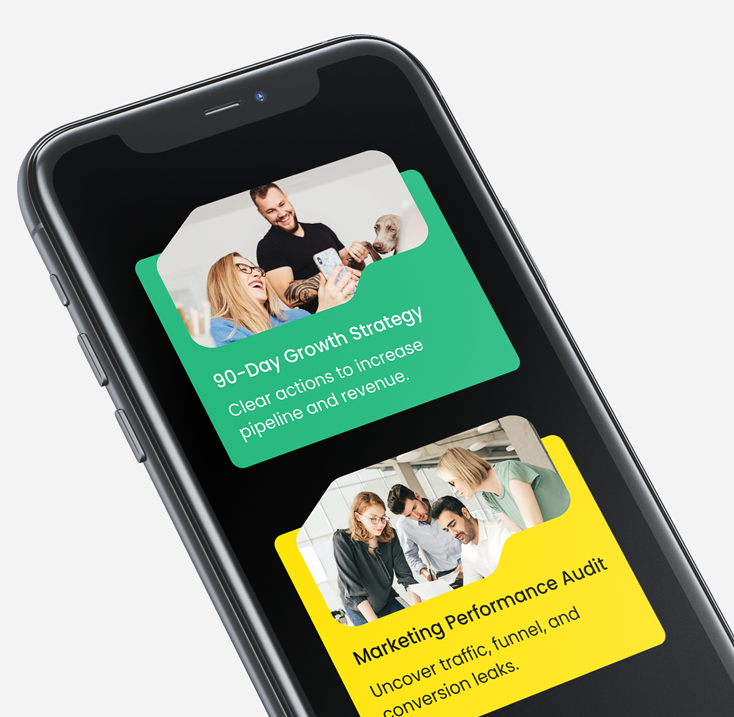
Growth marketing agency free marketing plan: 90-day growth strategy and marketing performance audit to uncover traffic, funnel, and conversion leaks

Pipeline Agent Pilot

An always-on AI rep that books B2B meetings in weeks.

Launch the Pilot
  • Business KPI locked in the contract
  • Named engineers on every sprint
  • Eval suite runs before every deploy
  • Guardrails and monitoring included
  • Human review on every workflow
  • Weekly cost per action reporting
  • Every build ends with a go/no-go

B2B AI agent fit criteria

Who our AI agent development is built for.

Good fit: B2B companies from $2M to $100M in revenue, with $50K to $500K agent budgets, a clear use case, data access, and a KPI owner.

Not a fit: no use case beyond wanting AI, consumer chatbots, or autonomy with no guardrails.

Tell us what's broken.

Questions buyers ask on the first call

AI Agent Development Company FAQs

An AI agent development company scopes the use case, builds the agent with RAG over your data, adds guardrails and evals, deploys it on your cloud, and monitors it in production. For B2B teams, the work is tied to one number: meetings, tickets, or hours.
Agent build, RAG, guardrails, an eval harness, monitoring, and human-in-the-loop review, plus a post-launch pod for tuning and model swaps. Discovery is paid and scoped first, and every engagement ships with no 12-month lock.
Market guides for 2026 put simple single-workflow agents near $5K to $25K, custom builds at $25K to $100K, and enterprise multi-agent systems above $100K. We quote a fixed price per milestone after discovery, so cost is known before build starts.
A scoped agent can be live with pilot users in 60 to 90 days. Complex multi-agent systems run longer, usually four to six months. The fastest path is one workflow, one KPI, and an eval set built from real cases in week one.
Every agent ships grounded in your approved data, with input and output validation, adversarial prompt testing, and monitoring in production. Human review stays on high-risk actions, and access is scoped to the data each workflow actually needs.
Whichever the workload calls for. LangGraph for durable enterprise orchestration, CrewAI for role-based agent teams, AutoGen for research loops, and native SDKs when latency or cost is the constraint. The framework serves the outcome, never the other way.

Your competitors have agents shipping.

We build the agent, the guardrails, and the pipeline it feeds, and tie it all to one number.

Talk to a Strategist